
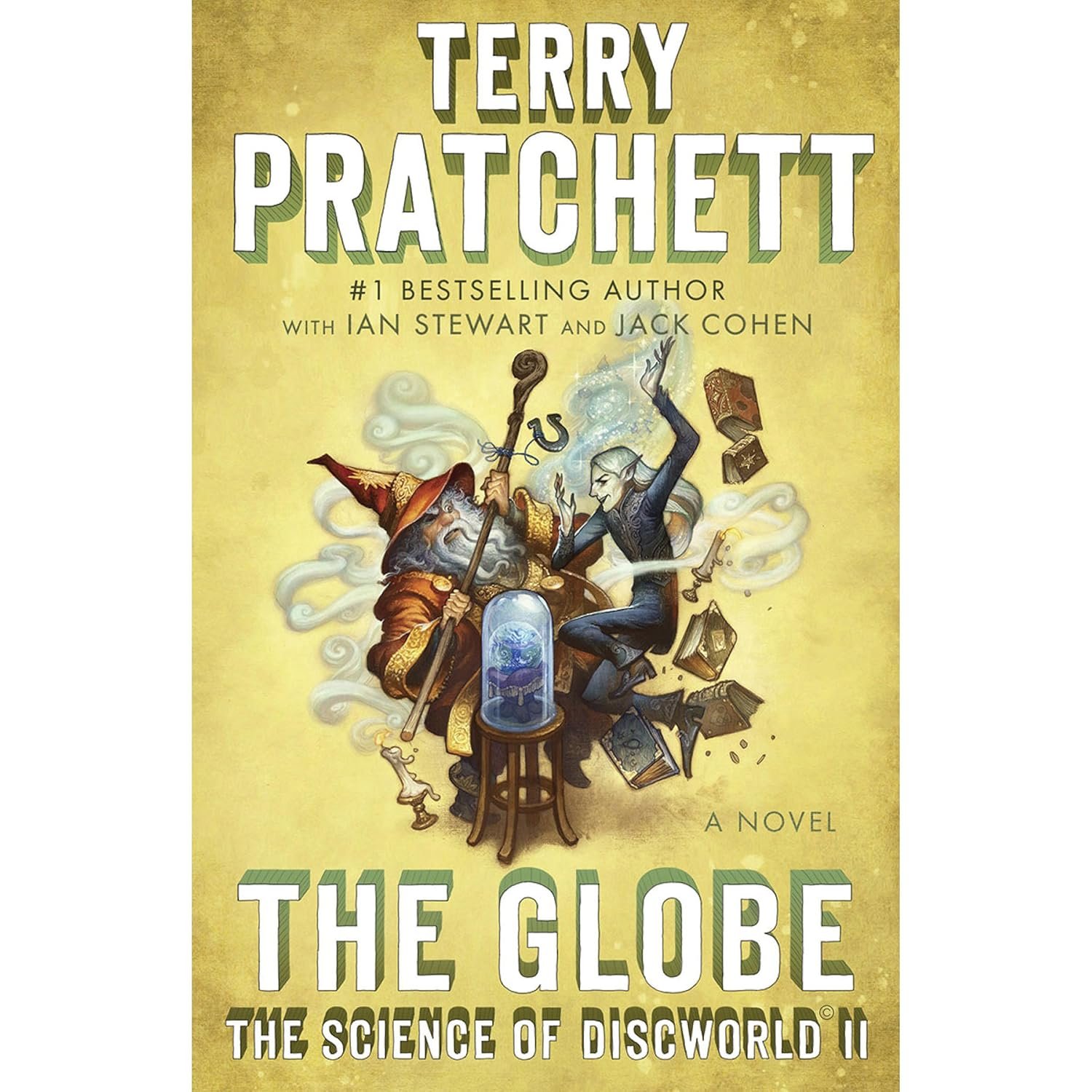
The Globe: The Science of Discworld II: A Novel
$0.99
Related Products




Roundworld, aka Earth, is under siege. Are three wizards and an orangutan Librarian enough to thwart the Elvish threat?
When the wizards of Unseen University first created Roundworld, they were so concerned with discovering the rules of this new universe that they overlooked its inhabitants entirely. Now, they have noticed humanity. And humanity has company. Arriving in Roundworld, the wizards find the situation is even worse than they’d expected. Under the elves’ influence, humans are superstitious, fearful, and fruitlessly trying to work magic in a world ruled by logic. Ridcully, Rincewind, Ponder Stibbons, and the orangutan Librarian must travel through time to get humanity back on track and out of the dark ages.
The Globe goes beyond science to explore the development of the human mind. Terry Pratchett and his acclaimed co-authors Ian Stewart and Jack Cohen combine the tale of the wizards rewriting human history with discussions of the origins and evolution of culture, language, art, and science, offering a fascinating and brilliantly original view of the world we live in.
Lydia M. Uribe –
Reviewing the whole series, volumes I through IV.
Excellent reading for anyone with an interest in science — how it works, why it works and the current state of various fields, from evolution to astrophysics to quantum mechanics and beyond. If you occasionally find yourself debating creationists, flat-earthers and the like, you’ll like these. You may also find that some things you thought were true aren’t quite and your own knowledge in need of the provided updating. That said, a caveat as to what you’ll be getting into:The titles and front covers are slightly deceptive marketing ploys. The publisher is well aware that there’s a huge market demographic that will buy anything with Terry Pratchett’s name on it, doubly so if accompanied by “Discworld.” Thus Pratchett’s name is prominently displayed, as is the title, while the two main authors (Ian Stewart and Jack Cohen) are a fine print afterthought. In fact, Pratchett’s contribution amounts to four related short stories spread in alternate chapters throughout the books. The bulk of the volumes are a discussion of our Earth’s (“Roundworld”) science, occasionally taking cues from the antics of Pratchett’s Discworld characters.That’s not to say you won’t be getting your money’s worth. Stewart and Cohen are excellent authors in their own right with numerous popular science and science fiction books to their credit. With Pratchett’s help they make the history and philosophy of science and its methods entertaining as well as educational. For me, at least, their chapters were every bit as much “page turners” as Pratchett’s contribution.(Note: The “some violence” rating is because, over the long haul, the Earth is a violent place with earthquakes, meteor strikes, ice ages, etc., and these are described. There is practically no human on human violence in the book.)
Calvert –
Mental Floss
I found this on the Kindle while looking for more about Terry Pratchett, since his Discworld novels are simultaneously entertaining and thought-provoking. At first glance the authors use Discworld as a soapbox for their views, and this is confirmed by second and third glances too (seemed to me it was full of more preachitooium than narrativium). What book isn’t heavily loaded with the author’s view of reality? Usually with a novel we expect the authors’ views to be embedded in the story. The format here alternates between Discworld story and essay, which is a cheat for getting the reader to understand their intent. Jokes that have to be explained are not funny, and novels that have to be explained by the authors aren’t terribly effective as novels. For all that, it is still a worthwhile read.I spent the first third of the book arguing in my head with the authors. Then I looked up the authors and got a better understanding of their viewpoints, so the middle of the book was more of a debate. The last third is what earned four stars. I feel as though my mind has been thoroughly brushed and flossed at this point, which is probably what the authors intended. This book takes effort to read, and I’m not sure any amount of effort on my part will help me understand all of it. I earned my liberal arts degree in the 1980’s, so one can imagine that I was in serious need of mental exercise.The essay portions of this book have, in my biased opinion, an Atheistic bemt. Any readers bothered by that may want to bypass this book.
gtmoore –
Not a regular “Discworld”, but brilliant.
Terry Pratchett was an excellent writer, and this book is extremely enjoyable, but more, his philosophy is profound. His concept of “Narativium”, as it acts in this world, is very well expressed. I find it to be the best one he has ever written. If you read for his ideas as well as his entertainment, you will too. I’m sure that if you like his books just for entertainment, you might not mark it as number one, but it is still better than any of his competitors. There are a half-dozen science fiction books that express a world view that is profoundly ahead of their time and as potentially life-changing as their science. This is one of them.
Jill B. –
Genius- can’t believe how good this is
I only read this because I’d exhausted the main DiskWorld novels, but what an amazing surprise. It’s fascinating, hilarious, genius. I’ve learned so much about things I never thought I’d care about, all because they connected it to DiskWorld and the writing is soooo good!
alan jackson –
LOVED IT – AS ALWAYS
I am probably biased. I adore and admire intelligent and informative writing which tackles complex subjects in a form that the uninitiated can readily comprehend… Messrs. Pratchett, Stewart and Cohen are masters at this rather obscure area of current literature.The concept of humans requiring ‘narrativium’ (or a story-structure into which they can fit the wilder excesses of their ambitions) had long been a subliminal conviction for me and here I found it artfully described. If you happen to have an unshakably conventional world-view then perhaps this book won’t have the same impact.Some readers might find the discussion of faith topics sacrilegious; all I can say to this is that I am sure your god (or gods) will probably commend your curiosity and might take your enhanced sense of wonder at the universe into mitigation.Buy the entire ‘Science of Discworld’ series. Read them, think about them, read them again. Ask questions… Never stop asking questions.
Arne –
Wissenschaft kombiniert mit Unterhaltung!Leicht zu lesen, sehr informativ!
HENDERSON Xavier –
sous couvert du disque monde, de nombreux concepts maths et sciences physique et naturelles sont abordéspour ados et adultes
j-beda –
A great framing device to discus non-fiction topics. I enjoyed it immensely. Maybe not so great if you are not already a fan of the Diskworld, but certainly fabulous if you are.
Tarotlover –
I’m a total Terry Pratchett fan. So I have to read it to see what happens. It is number two of four volumes. I had to buy it to read the rest.
Gadget Carousel –
The Science of Discworld II: The Globe is the second installment in the Science of Discworld series.The Globe brings us back to Unseen University, where the wizards once again meddle with the experimental “Roundworld” project—a parallel universe that suspiciously resembles our own Earth.